
You see it every day.
The subtle signs of pressure in your students – the overwhelm, the uncertainty, the moments when motivation slips or anxiety rises just beneath the surface.
You know your learners well. You notice the small changes: the student who withdraws a little, the one who suddenly stops participating, the one who’s clearly trying hard but struggling to keep up. And you also know that many of these young people don’t meet the threshold for formal mental health support, yet still need something steady, structured and practical to help them stay on track.
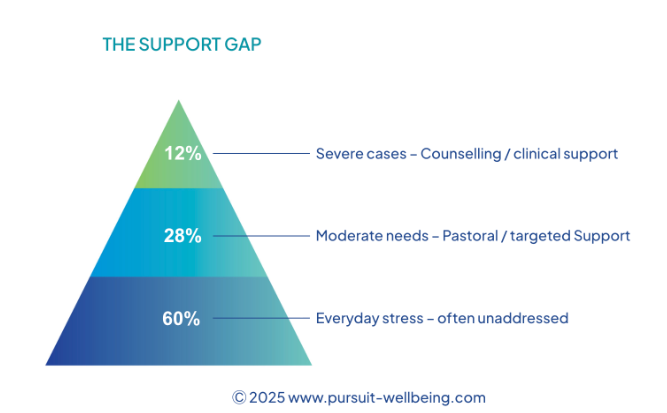
This is the support gap.
Students who aren’t in crisis, but aren’t thriving either.
Students coping – just – but quietly overloaded.
Students who don’t require clinical intervention, yet would benefit profoundly from tools that help them regulate emotions, manage stress and build resilience day to day.
Many college leaders tell me that this is the group that concerns them most. Not because they’re overlooked, but because the system simply isn’t designed around their needs. Staff carry the emotional load with enormous care, but with limited time and capacity, it’s easy for these quieter struggles to go unaddressed.
Understanding this support gap, and acknowledging its scale, is crucial to supporting student mental health in post-16 settings.
Why the Support Gap Matters So Much
You already have strong provision in place for students with higher-level mental health needs. Safeguarding teams, pastoral leads, counsellors, learning support and external services all play a vital role.
But the largest group of students sits at the base of the wellbeing pyramid – the students managing everyday stress that rarely gets allocated formal support. This is where declining attendance often begins. Where confidence ebbs. Where focus and motivation start to fluctuate. Where small setbacks feel enormous, and students worry silently about falling behind.
These aren’t “problems to fix.”
They’re completely normal human responses to the pressure young people are under, especially in post-16 education, with its intensity, exams, uncertainty about the future and rapid pace of change.
This also aligns closely with the updated EIF focus on inclusion and wellbeing, which emphasises that every learner should feel safe, supported and able to access the curriculum without unnecessary barriers.
But without proactive tools and support, that everyday stress can build until it becomes harder to manage.
By naming the support gap, we’re not pointing to a deficit.
We’re recognising a reality that every college leader sees and feels.
And because you already know your students so well…
This isn’t about teaching you anything new about your learners. You already read the room. You instinctively understand the rhythms, pressures and emotional weather of your college.
What leaders often tell me, though, is that they want:
- A shared language for supporting student wellbeing
- Something practical to help tutors feel more confident in conversations about stress
- Simple tools that students can actually use
- Approaches that don’t overwhelm staff or require clinical expertise
- A way to support the “in-between” students who are struggling but not escalating
And above all:
Support that sits alongside the systems they already have, not a new initiative to squeeze in.
That’s where practical, evidence-informed approaches to student wellbeing can make an enormous difference. Not by adding more, but by lightening the pastoral load and strengthening what’s already working.
What Students Need Most Right Now
Across every college I work with, students consistently need help with four things:
1. Managing stress in real time
Not theoretical wellbeing, but tools they can use immediately when emotions rise or overwhelm hits.
2. Regulating emotions
Understanding how stress works in the body and knowing simple ways to calm and reset.
3. Rebuilding motivation and confidence
Especially after setbacks, dips in attendance or challenges at home.
4. Improving focus and learning habits
Not through pressure, but through clarity, achievable routines and an understanding of how their brain works.
None of this replaces mental health services.
It complements them, meeting students exactly where they are, especially those in the support gap.
How Staff Benefit Too
Supporting student mental health in college settings isn’t just about students.
Leaders often share that they want their teams to feel:
- more confident responding to everyday stress
- less stretched by emotional demands
- supported by consistent approaches across the college
- reassured that they don’t have to “fix” everything
When staff have simple, shared strategies for wellbeing, everything becomes calmer. Students feel safer. Tutors feel more capable. The whole-college wellbeing approach strengthens, gently, steadily, sustainably.
If your college is exploring structured wellbeing support…
If your college is looking for something practical to support students in this support gap, something structured, flexible and easy for tutors to deliver, Secrets to Your Peak Performance may be one option to explore.
It gives students simple, science-backed tools to manage stress, build resilience, improve focus and feel more in control, while giving staff clear guidance and support.
If you’d like to explore whether this approach could support your students and lighten the load for your staff, you’re very welcome to download the information pack here: