

Why Most Wellbeing Strategies Miss the Students Who Need It Most
Most sixth form colleges already have strong support in place for student wellbeing.
Safeguarding teams, pastoral leads, counsellors, learning support all play a vital role, particularly for students with more complex or acute needs.
But when I speak to college leaders, the question is rarely about those students.
It’s about the much larger group who don’t sit at either end of the spectrum.
Students who are:
- attending, but not always fully engaged
- coping, but only just
- not in crisis, but not thriving either
This is where attendance often starts to dip.
Where confidence starts to erode.
Where motivation becomes inconsistent.
And where, without the right support, things can begin to unravel.
The Support Gap
This is what we call the support gap.
Not a gap in care or commitment, but a gap in provision.
Because while support is rightly in place for:
- students with significant or clinical needs
- students requiring targeted pastoral support
The largest group of students are navigating everyday stress with very little structured support.
This is often how support is structured in practice:
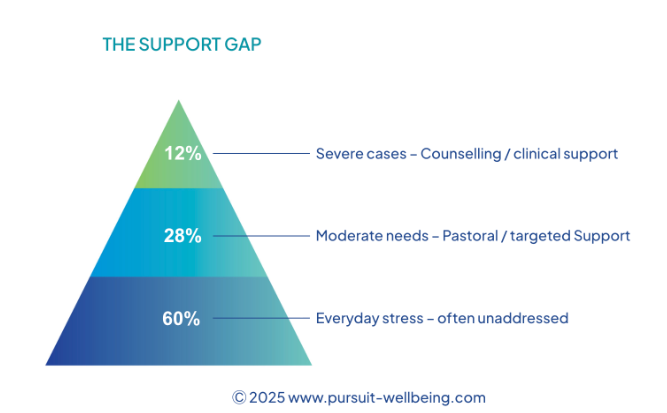
The majority of students sit at the base, managing pressure that rarely reaches the threshold for intervention, but still has a direct impact on:
- attendance
- focus
- confidence
- motivation
This is where a whole-college approach to student wellbeing makes the greatest difference.
Wellbeing Is Not Separate from Performance
One of the most important shifts for leaders is moving away from the idea that wellbeing and academic performance are competing priorities.
In reality, they are inseparable.
When students feel overwhelmed or under pressure, their ability to concentrate, retain information and manage challenge is reduced. Even highly capable students can begin to struggle.
Not because they lack ability, but because their capacity is compromised.
When students feel calmer, more settled and more in control of themselves, something shifts.
Focus improves.
Motivation returns.
Learning becomes more accessible.
A whole-college approach recognises that how students feel directly shapes how they perform.
Where the Real Work Lies
The support gap is not always visible.
These students don’t always come to the attention of pastoral teams.
They don’t meet thresholds for additional support.
But they are often the group most at risk of gradual disengagement.
Not suddenly.
But slowly.
A missed lesson here.
A drop in effort there.
A growing sense that things feel harder than they used to.
This is not a motivation problem.
It’s often a capacity problem.
And this is where early, proactive support has the greatest impact.
Build Understanding, Not Just Support
Students are often expected to manage their stress, but rarely shown how.
A sustainable approach to student wellbeing doesn’t just offer support, it builds understanding.
It helps students recognise:
- what happens when they feel under pressure
- how that affects focus, memory and decision-making
- the early signs that they are becoming overwhelmed
And crucially, it gives them simple, practical ways to respond.
Not abstract ideas.
Not one-off assemblies.
But usable strategies that help them:
- steady themselves
- refocus their attention
- stay engaged with their learning
When students understand how they work, they are far more able to stay on track, even when things feel challenging.
Support Earlier, Not Just More
This is where many wellbeing strategies fall short.
They are either:
- reactive (responding once problems have escalated)
or - too broad to create meaningful change
A whole-college approach focuses on closing the support gap.
When students are equipped with practical ways to manage pressure, regulate their responses and maintain focus:
- they are less likely to disengage
- attendance improves
- pressure on pastoral teams reduces
This is not about adding more support.
It’s about making the right support available earlier.
Keep It Simple and Sustainable
College leaders are rightly cautious about introducing new initiatives.
Anything new has to:
- fit within existing structures
- be deliverable by staff without adding pressure
- be consistent across the student experience
That’s why the most effective approaches are:
- structured
- practical
- easy to embed
Using tutor time, enrichment slots, or short, repeatable inputs allows wellbeing to be woven into the fabric of the college, rather than added on top.
Sustainability matters more than scale.
Create a Culture of Steadiness
Students don’t just learn from what is taught, they learn from the environment around them.
They notice:
- how adults respond under pressure
- how expectations are communicated
- whether interactions feel calm or urgent
- whether they feel seen and understood
When the environment is consistent, calm and clear, students feel safer and when students feel safer, they are better able to manage themselves.
A whole-college approach is not just about programmes or content.
It’s about the day-to-day experience of being in college.
Small things matter:
- how conversations are handled
- how pressure is managed
- how students are spoken to
Over time, these shape a culture where students feel more capable of managing both their learning and themselves.
A Practical, Preventative Approach
The most effective wellbeing strategies are not reactive.
They don’t wait for students to struggle.
They create the conditions where fewer students reach that point in the first place.
When students:
- understand how they respond to pressure
- feel more in control of themselves
- have simple tools they can use when things feel hard
they are far more likely to:
- stay engaged
- attend consistently
- perform at their best
And importantly, this reduces the load on staff, who are often carrying significant emotional responsibility.
Where Structured Support Makes the Difference
This is exactly where structured, practical approaches make the greatest impact.
Not as an add-on, but as a way of ensuring that all students, particularly those in the support gap, have access to:
- clear understanding
- simple, usable strategies
- a consistent language and approach
We designed our Peak Performance programme with this in mind. To support post-16 students with practical, science-informed tools they can use immediately to manage pressure, improve focus and stay engaged.
Final Thought
Sixth form is a uniquely demanding stage.
For many students, it is the first time academic pressure, future uncertainty and personal development all converge.
A whole-college approach ensures that students are not left to navigate this alone.
By recognising and closing the support gap, building understanding, and embedding practical strategies, colleges can create an environment where students don’t just cope – they continue to grow.
And when students feel better, they learn better.
Find out more about Peak Performance for post-16 students